
By: Ramy at Genuine Tea | 5 minute read
It's 11 p.m., the reading isn't done, and the vending machine down the hall has a can that promises to fix that in about four minutes. Energy drinks are the default study fuel on most campuses now, and it's easy to see why: they're fast, they're everywhere, and they work, for a while. The problem isn't that they don't deliver energy. It's what that energy costs you two hours later, and again at 2 a.m. when you're still wired enough to stare at the ceiling instead of sleeping before your 9 a.m. exam.
Matcha runs on a different mechanism. It pairs caffeine with L-theanine, an amino acid that blunts the jittery edge without blunting the alertness, in doses close enough to what the clinical research on the combination actually tested. This isn't a claim that matcha is "healthier" in some vague wellness-aisle sense. It's a specific, mechanism-level difference in how the caffeine hits your nervous system.
TL;DR:
- Matcha pairs caffeine with L-theanine, an amino acid that smooths out the jitters and the crash instead of leaving you to ride them.
- Caffeine and L-theanine work together to produce calm, sustained focus, the kind of steady energy that carries you through a full day of classes rather than spiking and dropping between them.
- Energy drinks give you the spike without the safety net: 80 to 300 mg of caffeine per can, nothing to offset the crash, and a growing body of research linking daily use to worse sleep.
- For a daily back-to-school habit, matcha also costs less per serving than a single energy drink at major Canadian grocers. Calmer focus, better sleep, lower cost.
Quick Comparison: Matcha vs. Energy Drinks
| Katō Matcha (2.5g serving) | Typical Energy Drink | |
|---|---|---|
| Caffeine | ~60 mg (Spring Harvest) | 80–300 mg |
| Focus pattern | Gradual onset, sustained via L-theanine | Fast spike, followed by a crash |
| Added sugar | 0 g (whole leaf, no additives) | 0–54 g depending on brand |
| Health Canada compliance | Not a regulated "energy drink" category - it's a tea! | Capped at 180 mg caffeine/serving |
| Daily-use sleep data | No sleep-disruption studies exist at this dose; evidence gap, not a documented clean bill | Daily use linked to ~30 fewer minutes of sleep/night |
| Cost per serving (CAD) | $1.43–$2.91 | $3.29–$5.99 (Loblaws) |
| Prep | Whisk 1–2g with 60–70mL hot water, ~1 minute | Open can |
The clinical trials behind that "calm focus" claim are 2008, 2010, and 2025 studies on L-theanine plus caffeine specifically, not on matcha as a beverage; the next section walks through what each one actually found.
Which Actually Gives You Sustained Focus, Not Just a Spike?
Caffeine alone works by blocking the receptors that make you feel tired, which is why it's fast and why it's also why the crash exists: block the tired signal for three hours and it doesn't go away, it queues up. L-theanine works differently. It crosses the blood-brain barrier, supports the brain's main calming neurotransmitter system, and appears to increase alpha brain waves, the pattern researchers associate with relaxed, ready attention rather than a jittery one.
The combination has been tested directly, more than once. A 2008 UK trial gave 27 adults either 50 mg of caffeine alone or the same dose with 100 mg of L-theanine; the combination improved attention-switching speed and accuracy faster than caffeine by itself (Owen et al., 2008). A 2010 follow-up with a different ratio found the same pattern, plus less mental fatigue over a long stretch of demanding work (Giesbrecht et al., 2010). A 2025 trial pushed the dose higher and tested it on sleep-deprived adults who'd been awake for 17 hours: the combination sped up reaction time on a selective-attention task and improved accuracy versus placebo, with EEG data backing it up (selective attention study, 2025). Three research groups, three dose ratios, the same directional finding.
Straight caffeine doesn't have an equivalent offsetting mechanism. It gets you alert. It doesn't do anything to prevent the crash on the other side of that alertness, and the higher the dose, the further you have to fall.
What's Actually in the Can vs. the Cup?
A Red Bull is 80 mg of caffeine. A Monster is 160 mg. Celsius and Alani Nu run 200 mg, and Bang or Reign hit 300 mg in a single 16 oz can, before you've had a second one to get through the library until close. Sugar varies by brand: a Red Bull carries 27 g (Red Bull), a Monster about 54 g (Men's Journal, 2026), while Celsius, Alani Nu, and Bang market themselves as zero-added-sugar.
Those are US label numbers, the ones you'll hit first searching a brand or reading a can photographed south of the border. Canada doesn't allow several of them at those exact numbers: Health Canada caps caffeinated energy drinks at 180 mg per serving (the dashed line above), so Celsius, Alani Nu, and Bang or Reign as sold in the US would need reformulating to sell here at all (Health Canada). Bang's Canadian can, for instance, ships at 180 mg rather than the US can's 300 mg. Katō Matcha isn't regulated under that category at all, since it's tea rather than a formulated energy product, but a 2.5 g serving sits comfortably under the cap either way.

A 2.5 g serving of our Katō Matcha, Organic Spring Harvest works out to roughly 60 mg of caffeine, comfortably below even a Red Bull, paired with a meaningful dose of L-theanine from the leaf itself. That's the tradeoff: less raw caffeine, but caffeine that arrives with its own counterbalance built in, rather than caffeine and nothing else. If you're chasing a specific number over a specific stretch of time, an energy drink gets you there faster. If you're trying to get through a three-hour study block without a crash in the middle of it, the ratio matters more than the raw milligrams.
Which One Can You Actually Drink Every Day During Exam Season?
This isn't a once-in-a-while question for a lot of students. At the University of Iowa, the share of students drinking energy drinks or shots five or more days a month climbed from 9% in 2021 to 21% in 2023 to 32% in 2025, well above the 18.5% national figure for spring 2025 (The Gazette, 2025). A separate 2025 survey of over 1,500 US undergraduates found 25% favour energy drinks as their primary caffeine source, second only to coffee, and 75% of respondents reported jitters, anxiety, or other negative side effects from their overall caffeine intake (Grand Canyon University, 2025; self-reported survey data, disclosed here as such).
The sleep data is where daily energy drink use catches up with you. A study of 53,226 Norwegian university students found daily energy drink consumers slept roughly 30 minutes less per night than non-consumers, about 7:06–7:10 versus 7:39. They also reported insomnia symptoms at close to 1.5 times the rate: 51% of women who drank daily versus 33% of non-consumers, 37% of men versus 22% (Kaldenbach et al., BMJ Open, 2024).
Separately, an American Heart Association scientific statement published in Circulation this year concluded that high-dose caffeine from energy drinks is linked to elevated blood pressure and abnormal heart rhythms. The risk shows up "particularly in healthy adults under 30" (Marcus et al., Circulation, 2026).
There's a regulatory angle here worth knowing if you're buying in Canada: Health Canada caps caffeinated energy drinks at 180 mg per serving (max 400 mg per litre), which is lower than what several popular US brands sell at in a single can before any reformulation (Health Canada). Matcha isn't regulated under that category at all, since it's tea, not a formulated energy product, so the comparison isn't apples to apples on labeling. It is a reasonable proxy for how much more concentrated a can of Bang or Reign is than what Canadian regulators consider an appropriate single serving of anything caffeinated.
Cost Per Study Session
| Katō Matcha | Format | Price | Servings (2.5g each) | Cost/serving |
|---|---|---|---|---|
| Summer Harvest | 40g tin | $24.95 | 16 | $1.56 |
| Spring Harvest | 30g tin | $29.95 | 12 | $2.50 |
| Organic Spring Harvest | 30g tin | $34.95 | 12 | $2.91 |
| Fruit Matcha (e.g. Strawberry) | 40g tin | $22.95 | 16 | $1.43 |
We just lowered Katō Matcha prices across the line as of August 16, 2026, which is what the table above reflects. Loblaws, one of Canada's largest grocery chains, lists Red Bull at $3.29 CAD for a 250mL can and $5.99 CAD for a 473mL can (Loblaws, retrieved 2026). Convenience-store pricing runs in a similar range depending on location. A genuinely daily habit through a 14-week semester (98 days) works out to roughly $141 to $285 for matcha at $1.43–$2.91 per serving, against $322 to $587 for a daily energy drink at $3.29–$5.99 per can. Even the cheapest matcha option costs less per serving than the cheapest energy drink can, and the gap widens fast once you're buying one of each, every day, for a full term.
Which Katō Matcha for Which Study Need

Pulling an all-nighter or need deep, sustained focus for a paper or problem set: Organic Spring Harvest is the pick. It's shaded for a full 30 days before picking, longer than the summer harvest's 20, which is why it runs highest of the Katō line in both caffeine and L-theanine. Whisk it traditionally, hot, and drink it while it's fresh rather than letting it sit.
Daily afternoon pick-me-up, or you want it in a latte instead of a bowl: Summer Harvest is built for that. It has a bolder, more robust flavour that holds up to milk, comes in larger formats (250g, 1kg) for a habit you're keeping all semester, and runs the lowest cost per serving of the three.

New to matcha, or you want something that's a bit fruitier at 8 a.m.: the Fruit Matcha line (Strawberry, Yuzu, Coconut) mixes real freeze-dried fruit into the same base leaf, no added sugar. These flavours sell out often. If the one you want is out of stock, our Matcha Club subscription gets you first access to restocks rather than waiting on a general announcement.
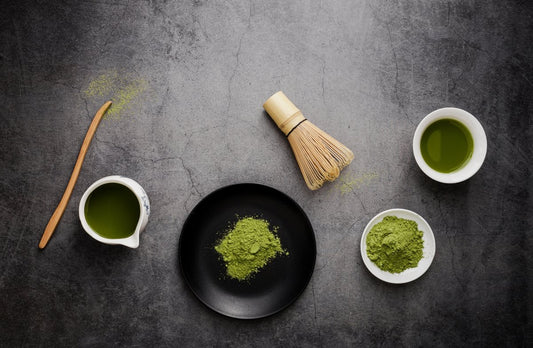
How to actually make it in a dorm room: whisk 1–2g (about ½–1 tsp) with 60–70mL of hot water around 80°C until frothy, using a small whisk, a milk frother, or even a fork in a pinch. No espresso machine, no kettle with a temperature dial required, just water that's hot but not boiling.
Frequently Asked Questions
Does matcha actually have caffeine, or is it mostly hype?
Yes. Because matcha is the whole ground leaf rather than a steeped-and-discarded infusion, it delivers a meaningfully higher share of the leaf's caffeine and L-theanine than a regular cup of steeped tea. A 2.5g serving of a well shade-grown matcha like our Organic Spring Harvest works out to roughly 60mg of caffeine, on the same order as a standard energy drink, just lower and paired with L-theanine.
How much matcha caffeine is safe before an exam?
The American Heart Association's general guidance puts safe daily caffeine intake at up to 400mg for healthy adults (Marcus et al., Circulation, 2026), which is around six to seven 2.5g servings of Katō Matcha. Health Canada's separate 180mg-per-serving cap on energy drinks is a useful reference point for a single sitting, even though matcha isn't regulated under that category. Individual caffeine sensitivity varies, and this isn't medical advice for a specific health condition.
Will matcha actually keep me focused through a study session, or will I crash like with coffee?
The L-theanine and caffeine combination has shown improved attention-switching accuracy and reduced mental fatigue over sustained, effortful tasks compared to caffeine alone across three separate clinical trials. That's a documented pattern in the research, not a guarantee for any individual session, since caffeine sensitivity and sleep debt both affect how any caffeinated drink performs for a given person.
Can I bring matcha to campus without special equipment?
Yes. A 2.5g serving whisked with 60–70mL of hot water takes about a minute with a hand whisk, a milk frother, or a fork. It also works cold: whisk it, then pour over ice, which several of the Katō Matcha product pages note as a preparation option for a summer or exam-week iced version.
The Verdict
| Category | Winner |
|---|---|
| Sustained focus without a crash | Matcha |
| Fastest possible energy | Energy drinks |
| Sugar and additive content | Matcha (ties zero-sugar brands like Celsius; beats sugared ones like Red Bull and Monster) |
| Cost per serving | Matcha |
| Sleep impact with daily use | Matcha |
| Convenience (grab-and-go) | Energy drinks |
| Overall, for exam-season focus | Matcha |
Energy drinks win on pure convenience: crack a can, done. For anything longer than the next 45 minutes, though, the L-theanine and caffeine combination in a properly shade-grown matcha is the better trade, backed by three separate clinical trials and a lot fewer 2 a.m. ceiling-staring sessions. Start with the 30-day shade-grown spring harvest if you want the highest-focus option, or browse the full Katō Matcha collection to find the harvest that fits your semester.